Thawing Ground, Vanishing Voices: The Race to Save Arctic Archaeological Sites Before They Disappear
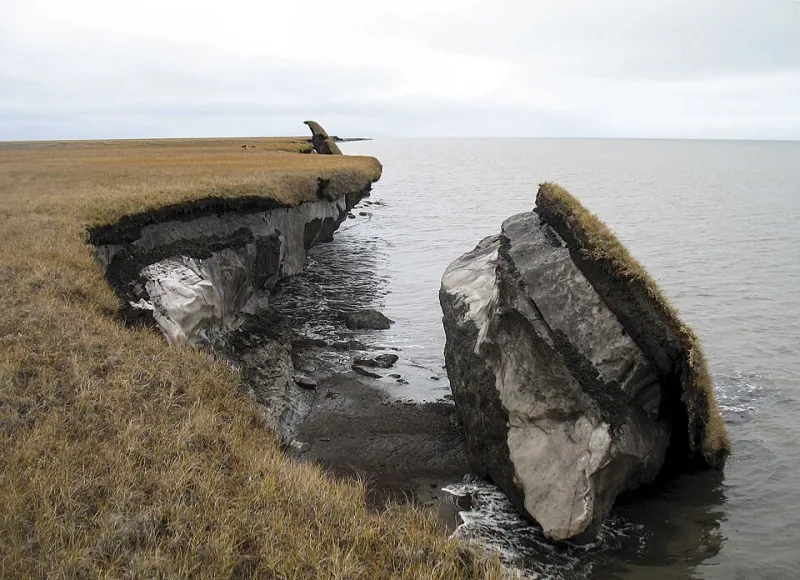
Photo: Benjamin Jones, U.S. Geological Survey, Public domain, via Wikimedia Commons
A Freezer Left Open
For thousands of years, the permafrost underlying Alaska's North Slope and the subarctic reaches of Northern Canada functioned as something no human institution could replicate: a perfectly stable, perpetually cold archive. Organic materials that would rot within weeks in temperate climates — wooden tools, animal hides, woven grasses, human remains — were locked in place, suspended in a kind of geological stillness. Archaeologists working in these regions have long understood that the frozen ground was not merely a backdrop to their work. It was, in many respects, the reason their work was possible at all.
That archive is now open. And it is not closing again.
As average annual temperatures in the Arctic rise at roughly four times the global rate, permafrost that has remained stable since the last Ice Age is thawing with alarming speed. In some areas of Alaska, ground that was frozen year-round just two decades ago now experiences seasonal melt cycles that penetrate several feet deeper than historical norms. The consequences for buried archaeological sites are severe and, in most cases, irreversible.
What the Frozen Ground Preserves
To understand what is at stake, it helps to consider what permafrost conditions actually yield when excavated under controlled circumstances. At sites like Nunalleq in southwestern Alaska — excavated collaboratively by the University of Aberdeen and Yup'ik community partners — archaeologists recovered wooden bowls, grass-woven baskets, decorated ivory objects, and the remains of structures that retained their original form after more than five centuries of burial. The organic preservation was extraordinary precisely because the cold had suppressed the microbial activity that would otherwise have consumed these materials entirely.
Such finds are not merely aesthetically remarkable. They carry detailed functional and cultural information that stone or ceramic artifacts cannot. The wear patterns on a wooden tool reveal how it was held and used. Residue preserved inside a vessel can be analyzed for dietary content. Cordage and textile fragments speak to technological traditions that left no trace in more arid or temperate archaeological records. In short, frozen sites offer a category of evidence that is simply unavailable elsewhere — and that evidence is now being destroyed before it can be studied.
Estimates from the Arctic Council and various university research programs suggest that a significant portion of known permafrost archaeological sites in Alaska alone show active signs of erosion or thaw degradation. Coastal sites face a compounded threat: as sea ice diminishes, shoreline erosion accelerates, and sites that were once protected by frozen bluffs are collapsing directly into the ocean.
Racing the Melt
Fieldwork in the Arctic has never been logistically simple. Remote locations, compressed summer seasons, and the sheer physical demands of operating in subarctic conditions have always constrained what researchers can accomplish in a given year. Climate change has not removed these obstacles — it has added urgency on top of them.
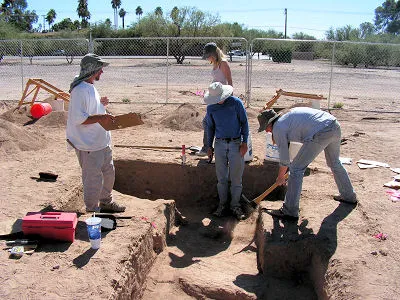
In recent years, a number of university programs and federal agencies, including the National Park Service's Shared Beringian Heritage Program, have prioritized what is sometimes called "salvage archaeology" in Arctic contexts: the rapid documentation and recovery of materials from sites identified as critically threatened. These efforts involve drone-based aerial survey, photogrammetric modeling, and accelerated laboratory analysis designed to extract as much information as possible before conditions deteriorate further.
But salvage archaeology, by its nature, operates under constraint. It is triage, not comprehensive study. Decisions must be made about which sites receive attention and which do not, and those decisions carry real consequences for what future researchers will and will not be able to know. The field is not simply racing against time — it is making painful choices about which portions of the past are worth the effort to save.
The Communities Behind the Artifacts
For Alaska Native communities, the thawing of permafrost sites is not an abstraction. The materials emerging from the ground — or being lost to it — are the physical heritage of living peoples whose oral traditions, cultural practices, and identities are directly connected to those objects and places.
Several tribes and Alaska Native corporations have become active participants in documentation and recovery efforts, insisting — rightly — that decisions about how to handle emerging materials must involve the communities to whom those materials belong. This has produced some genuinely collaborative models of practice, in which Indigenous knowledge holders work alongside university researchers not merely as consultants but as co-investigators who shape research questions and determine the disposition of recovered items.
The ethical dimensions here are considerable. When a site erodes into the sea before it can be excavated, the loss is shared — but it is not shared equally. For outside researchers, it represents a gap in the scholarly record. For the Yup'ik, Iñupiat, or Athabascan communities whose ancestors occupied those sites, it represents the permanent disappearance of something that cannot be replaced by any digital surrogate or archival description.
What We Lose When the Ground Forgets
The broader scholarly significance of Arctic archaeological sites extends well beyond any single culture or region. The Arctic has been occupied by human populations for at least 14,000 years, and the record of that occupation offers unparalleled evidence of how people adapted — technologically, socially, and cognitively — to some of the most demanding environmental conditions on the planet.
At a moment when contemporary societies are actively grappling with their own capacity to adapt to environmental disruption, that record carries a particular kind of relevance. The archaeological evidence from Arctic sites documents repeated cycles of cultural innovation and resilience: new hunting technologies developed in response to shifting animal ranges, architectural adaptations to changing thermal conditions, social networks that allowed communities to buffer against localized resource failures. These are not merely historical curiosities. They are data points in a long-term study of human adaptability — a study that climate change is now actively destroying.
The loss is compounding in another sense as well. Because organic preservation in permafrost is so exceptional, the Arctic record has historically filled gaps left by the more fragmentary evidence from other regions. As those sites vanish, the overall picture of early human movement, technological development, and cultural exchange across the northern latitudes becomes correspondingly less complete.
Preservation as an Ethical Obligation
The conversation about Arctic site loss tends to focus, understandably, on the practical and logistical dimensions of salvage work: funding levels, field season constraints, laboratory capacity. These are genuine concerns. But they exist within a larger ethical frame that deserves explicit attention.
If the destruction of these sites is being driven primarily by industrial carbon emissions — a global phenomenon disproportionately generated by wealthier, temperate-zone nations — then the communities bearing the most immediate cultural losses are also among those least responsible for the conditions producing those losses. That asymmetry should shape how funding priorities are set, how research agendas are constructed, and how the broader archaeological community understands its obligations to the peoples whose heritage is at stake.
The ground is thawing. What it releases will not wait for convenient schedules or adequate budgets. The question is not only whether we can save what remains — it is whether we are willing to treat the effort as the urgent moral priority it plainly is.