The Last Dig Before the Bulldozer: Inside America's Urgent World of Salvage Archaeology
Photo: Prime Minister's Office, GODL-India, via Wikimedia Commons
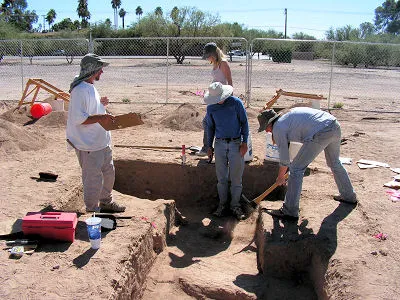
In the spring of 2014, workers preparing a site for a mixed-use development in downtown Nashville, Tennessee, struck something unexpected several feet below street level: a dense scatter of fire-cracked rock, ceramic sherds, and faunal bone that pointed unmistakably toward a pre-Columbian occupation. Construction halted. Archaeologists arrived. And for approximately six weeks, a small team worked in a narrow excavation corridor between survey stakes and equipment staging areas, recovering what they could before the project resumed.
This is salvage archaeology — or, in the formal regulatory language of American cultural resource management, "rescue excavation." It is unglamorous, deadline-driven, and frequently underfunded. It is also, by a significant margin, the way most archaeological fieldwork in the United States actually happens.
A Law, a Permit, and a Ticking Clock
The legal architecture that makes salvage archaeology possible in the United States is rooted primarily in Section 106 of the National Historic Preservation Act of 1966, which requires federal agencies to consider the effects of their undertakings on historic properties before proceeding. When federal funds or permits are involved in a construction project — a highway expansion, a federally backed development loan, a bridge replacement — that requirement triggers a review process that can mandate archaeological survey and, if significant sites are identified, mitigation through excavation and documentation.
The critical phrase is "mitigation through excavation." Under most circumstances, the law does not require that development stop permanently. It requires that the resource be documented before it is destroyed. This distinction has shaped the entire practice of cultural resource management in America: the goal is not necessarily preservation in place, but preservation in record.
Critics argue that this framework privileges development timelines over genuine heritage protection. Proponents counter that without it, countless sites would disappear entirely, without a single trowel stroke or photograph. Both assessments contain truth.
What Parking Lots Are Hiding
The richest irony of urban salvage archaeology is how often the most mundane features of the American built environment — parking structures, strip malls, highway on-ramps — turn out to overlie some of the most historically significant ground in the country.
In Richmond, Virginia, salvage excavations conducted ahead of a downtown development project in the early 2000s uncovered portions of a free Black neighborhood that had flourished in the decades following the Civil War. The material record — ceramic assemblages, structural footings, personal objects — documented a community that had left almost no trace in the written historical record. Without the construction project, and without the legal mandate that preceded it, those traces would have remained beneath the surface indefinitely, or been destroyed without documentation in a previous building cycle.
Similarly, in New Orleans, investigations conducted in advance of post-Katrina infrastructure repairs revealed stratified deposits spanning more than a millennium, from pre-contact Indigenous occupation through successive colonial and antebellum periods. Salvage conditions meant that excavation units were often small and the timeline compressed, but the recovered data meaningfully revised scholarly understanding of settlement patterns along the lower Mississippi.
In Phoenix, Arizona, a light rail expansion project became one of the most productive Hohokam investigations in the region's history, yielding canal segments, pit house features, and artifact assemblages that helped clarify the chronology of one of the Southwest's most sophisticated pre-Columbian irrigation societies.
The Archaeology of Necessity
Fieldwork conducted under salvage conditions differs in meaningful ways from research-driven excavation. The questions being asked are often shaped by what the construction footprint happens to cross rather than by scholarly priorities. Excavation units may be placed to satisfy regulatory requirements rather than to test specific hypotheses. The pace rarely allows for the kind of methodical, iterative investigation that academic projects afford.
And yet practitioners in this field argue, with some force, that salvage archaeology has produced a substantial portion of what is known about the American past. Research excavations are expensive, competitively funded, and geographically selective. Construction, by contrast, happens everywhere — in cities and suburbs, along rural highway corridors, on riverbanks and floodplains and ridge tops. The distribution of salvage projects tracks the distribution of human activity in ways that no research agenda could replicate.
"Development doesn't care about site significance," one cultural resource management archaeologist noted in a 2019 interview published in the journal Historical Archaeology. "It goes where the land is cheap or where the infrastructure needs to go. That turns out to be a remarkably unbiased sampling strategy."
The Limits of Documentation
The uncomfortable reality that salvage archaeology cannot entirely resolve is the gap between documentation and preservation. A site that has been excavated and recorded is not a site that has been saved. The physical context — the spatial relationships between artifacts, the intact stratigraphy, the buried landscape — is destroyed in the process of being studied. Future analytical technologies, including methods not yet invented, will never have access to that material.
This concern has sharpened in recent years as ancient DNA analysis, isotopic sourcing, and other laboratory techniques have revealed that even apparently mundane archaeological deposits contain biological and chemical information that older excavation methods could not have anticipated. Sites documented in the 1970s and 1980s under salvage conditions were often excavated in ways that did not preserve samples suitable for these analyses. The records survive; the data do not.
There is also the question of what happens to collections after a salvage project concludes. Cultural resource management firms are required to curate recovered materials and submit reports to state historic preservation offices, but long-term repository capacity across the United States is under significant strain. Tens of millions of artifacts and associated records sit in warehouses and storage facilities, catalogued but largely unstudied, waiting for researchers who may never arrive.
Racing the Machine
For the archaeologists who work in this field, the emotional reality of salvage work is difficult to separate from the professional one. There is, practitioners frequently report, something genuinely affecting about excavating a site in the knowledge that the ground will be gone within weeks — that the hearth you are uncovering, the post molds you are mapping, the broken vessel you are lifting from the matrix, will have no physical existence once the machines return.
That weight, however, is also what gives salvage archaeology its particular urgency and its particular value. The fire that drives this work — the recognition that the record is being consumed faster than it can be read — is the same fire that has driven archaeological preservation advocacy in the United States for more than half a century.
The bulldozer does not wait. Neither, increasingly, can the discipline that works in its shadow.
Toward a Better Framework
Advocates for stronger archaeological protection argue that the current regulatory model, while valuable, is insufficient. They point to the need for earlier site identification in the development planning process, expanded funding for in-place preservation where sites of exceptional significance are identified, and greater investment in public curation infrastructure to ensure that salvage collections remain accessible to future researchers.
Some states have moved in this direction. Maryland's "Smart Growth" legislation, for instance, has been used to steer development away from areas with high archaeological sensitivity, reducing the volume of rescue excavations required while preserving subsurface deposits intact. Similar approaches have been piloted in parts of the Southwest, where tribal consultation processes have occasionally resulted in project redesigns that protect culturally significant sites rather than simply documenting them before their destruction.
These are partial solutions to a large problem. But they suggest that salvage archaeology, at its best, need not be merely a rearguard action — a last dig before the bulldozer arrives. It can also be the evidence that changes where the bulldozer goes.