The Copper Age America Forgot: Fire, Trade, and Power in the Ancient Great Lakes
Long before Europeans arrived with iron tools and gunpowder, the lands surrounding Lake Superior were already home to one of the most remarkable technological traditions in the ancient world. The Old Copper Complex, a network of Indigenous metallurgical cultures centered in the Great Lakes region, was mining, heating, and working copper as many as 7,000 years ago — a timeline that places it among the earliest metalworking traditions anywhere on Earth.
For decades, this achievement was treated as a footnote in American archaeology. Today, a combination of new excavations, radiocarbon dating, and materials science is restoring the Old Copper Complex to its rightful place as the foundation of a genuinely American technology revolution.
The Oldest Metalworkers on the Continent
The story begins with geology. The Lake Superior basin holds one of the purest and most accessible copper deposits on the planet. In the wake of retreating glaciers, nuggets of nearly pure native copper lay exposed in streambeds and shoreline gravel — a metal that required no smelting to recognize, and none to begin working.
What archaeologists have documented at sites across Wisconsin, Michigan, and Minnesota is a tradition of deliberate transformation. Artifacts recovered from sites such as Oconto and Osceola in Wisconsin show clear evidence of annealing: the repeated heating of copper in hot fires to soften it before hammering. This is pyrotechnology in the truest sense — the controlled use of fire not for warmth or cooking, but for the manipulation of matter itself.
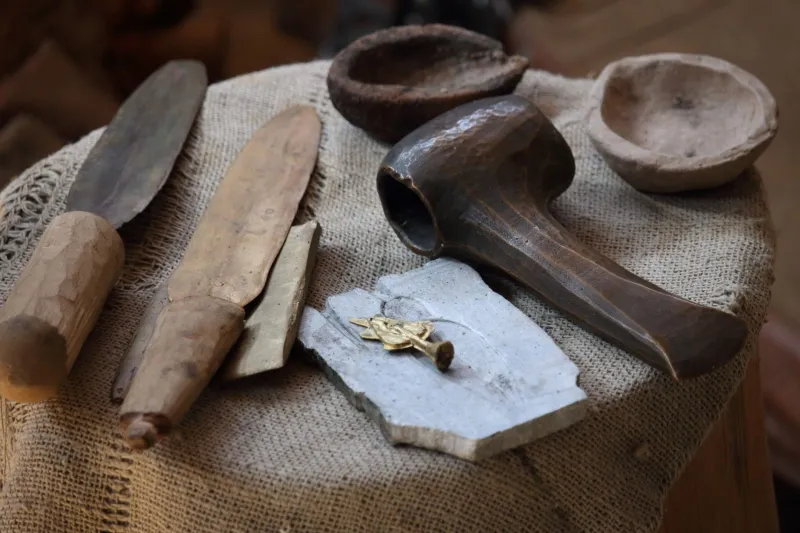
The resulting toolkit is distinctive. Spear points, knives, awls, and fishhooks, cold-hammered into shape and occasionally heat-treated, appear in archaeological contexts stretching from the Canadian Shield to the Gulf Coast. Some of these objects are more than five millennia old, which means Indigenous Americans were working metal while the great pyramids of Egypt were still centuries in the future.
Fire as Technology, Not Just Survival
Controlled fire is one of humanity's oldest tools, but its application to materials — what scholars call pyrotechnology — marks a conceptual leap. Annealing copper requires sustained temperatures approaching 200 degrees Celsius, enough to alter the metal's crystalline structure and allow it to be worked without cracking.
That knowledge did not spread by accident. The distribution of Old Copper artifacts traces what can only be described as a trade network, with Lake Superior copper appearing in burial contexts and occupation sites hundreds, sometimes thousands, of miles from its source. Copper objects have been recovered in the Ohio Valley, the Great Plains, and the Southeast, often in contexts that suggest they were objects of prestige rather than mere tools.
This pattern tells archaeologists something profound: the value of these objects was not purely practical. A copper spear point, after all, is heavier and less durable than one knapped from chert. The evidence increasingly suggests that copper's worth lay in its rarity, its shimmer, and the labor and knowledge embedded in it — a social currency as much as a material one.
Status, Ceremony, and the Shape of Society
Excavations at mortuary sites across the Upper Midwest have revealed copper's ceremonial role. At cemeteries associated with the Old Copper Complex and later Woodland-period cultures, copper ornaments, beads, and tools were interred with the dead, sometimes in quantities that indicate significant social differentiation.
The Koster site in Illinois and the massive Effigy Mounds of the Upper Mississippi Valley both show how copper moved through exchange systems that linked distant communities. In these contexts, copper functioned much like jade did in Mesoamerica or gold in the Andes — a material whose significance was defined as much by ritual and relationship as by economics.
This raises questions that continue to occupy researchers: Did the control of copper production and trade give certain families or communities enduring social power? Or was the system more fluid, with prestige earned and redistributed rather than hoarded? The archaeological record, fragmentary as it is, supports elements of both interpretations.
Why the Furnaces Still Puzzle Researchers
For all that has been learned, major questions remain. The most persistent concerns the absence of true smelting. Unlike contemporaneous metallurgical traditions in the Balkans or the Andes, Old Copper artisans never appear to have melted copper down or cast it. Some researchers argue this reflects a deliberate cultural choice — a technological philosophy in which the metal's natural form was respected rather than destroyed. Others suggest the region's abundant supplies of pure native copper simply made smelting unnecessary.
There is also the matter of chronology. Radiocarbon dates for Old Copper sites have shifted considerably over the past two decades, with some early claims of 9,000-year-old metallurgy now viewed skeptically while other dates have been pushed later. Reconciling these timelines remains an active area of research, complicated by the fact that copper itself cannot be directly dated.
Then there is the question of abandonment. By roughly 3,000 years ago, large-scale copper tool production had declined dramatically, even as copper continued to circulate as a prestige material. Whether this reflects changing trade routes, shifting burial practices, climate pressures, or something archaeology has yet to identify is still debated.
What the Old Copper Complex Means Today
The renewed scholarly attention to ancient North American metallurgy carries implications beyond academic debate. It challenges the long-standing — and long-discredited — narrative that Indigenous peoples of the Americas lagged behind Old World civilizations technologically. The Old Copper Complex demonstrates independent invention, sophisticated materials knowledge, and continent-spanning exchange, all developed without draft animals, writing, or the wheel.
For the descendant communities of the Great Lakes region, including the Ojibwe nations for whom copper retains deep cultural meaning, these findings affirm what oral traditions have long held: that the relationship between the people and the metal of Lake Superior is ancient, intimate, and ongoing.
Museums across Wisconsin, Michigan, and Minnesota have begun reinterpreting their Old Copper collections with this fuller story in mind, and repatriation conversations have brought new urgency to how these artifacts are stewarded. The metal that once moved along ancient trade routes is now moving through a different kind of exchange — between institutions, Indigenous communities, and the public.
The fire that ancient metalworkers tended beside glacial lakes was small, and its glow has long since faded. But the knowledge it represented — the idea that fire could transform the world — was a genuine revolution, and it burned first, in the Americas, on the shores of Lake Superior.