The Land Was Never Wild: Why Archaeology Is Vindicating Indigenous Fire Stewardship
There is a diagram buried in most American soil, and land managers spent the twentieth century pretending it wasn't there. It is a charcoal layer — sometimes many of them — running through sediment cores, hearth fill, and floodplain deposits across the continent. Each band marks a fire. Most of them were not lightning strikes.
As tribal nations in California, the Southeast, and beyond reassert their authority to burn, archaeology has quietly become an expert witness in a debate that policy debates alone could not settle. The evidence in the ground says what Indigenous communities never stopped saying: this was never untouched wilderness.
What the Charcoal Record Shows
Sediment cores from California's Sierra Nevada, the Klamath Mountains, and the coastal prairies of the Pacific Northwest show fire return intervals of just a few years to a few decades in many landscapes before the nineteenth century — far too frequent, and too seasonal, to be explained by natural ignition alone. After the period of forced removal and the criminalization of Indigenous burning, the record shows an abrupt decline in fire, followed by the fuel-choked, fire-starved forests we inherit today.
In the Southeast, the story repeats. Longleaf pine ecosystems, among the most biodiverse in North America, depend on frequent low-intensity fire — fire that archaeological and paleoecological evidence ties to sustained burning by Cherokee, Muscogee (Creek), and other nations, who burned to maintain open understories, improve game habitat, and encourage food plants like cane and chestnut.
Fire-scarred trees, sampled by dendrochronologists, tell the same story with annual precision: scars recording surface fires every few years for centuries, then silence after the 1850s to 1900s, when state suppression laws took hold.
The Myth That Had to Fall
The 'pristine wilderness' idea was never just a misunderstanding; it was a legal and moral instrument. Empty landscapes justified dispossession, and empty landscapes required empty fire. California's 1924 statute effectively banning cultural burning — a policy some officials explicitly tied to removing Native people from the land — rested on the fiction that fire was destruction rather than cultivation.
Archaeology undermines that fiction at every turn. Ethnobotanical remains in village sites show deliberate tending of fire-dependent species. Hearth distributions map onto landscape zones that historical ecologists now recognize as productive, managed mosaics. The absence of catastrophic fire deposits in the deep record — where we might expect them under a no-management regime — is itself evidence of careful stewardship.
The Revival, and the Reluctant Institutions
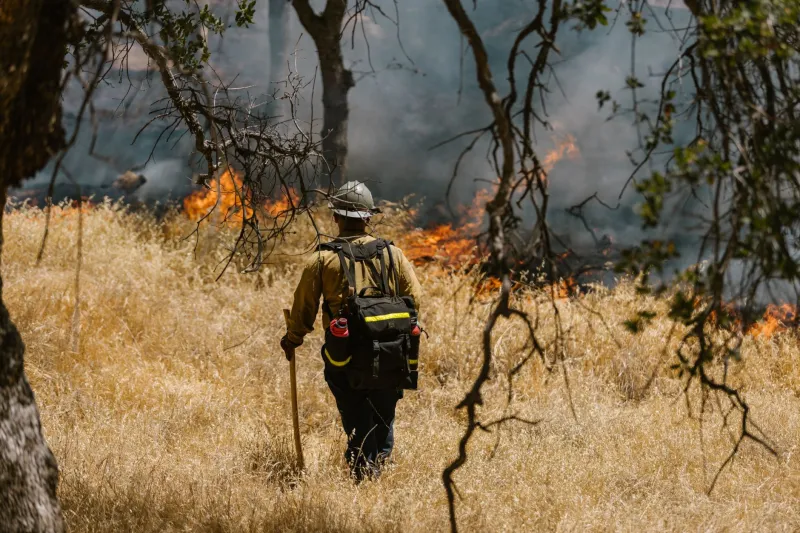
Today, cultural burning is returning. The Karuk Tribe in California runs one of the most advanced indigenous fire programs in the country. The Yurok Cultural Fire Management Council trains burn crews on ancestral territory. In the Southeast, the Eastern Band of Cherokee Indians has partnered with federal land managers to restore fire to tribally significant landscapes.
The obstacles are institutional as much as ecological. Prescribed burn permits, air quality regulations, and liability frameworks were all designed around suppression, not stewardship. Cultural burning also operates on a different calendar — one keyed to seasonal knowledge and community ceremony rather than agency planning cycles.
But the tide has turned in a way that would have been unthinkable twenty years ago. California has passed legislation recognizing cultural burning authority. Federal agencies, chastened by catastrophic megafires that suppression-only policy failed to prevent, are actively seeking tribal partnerships. The shift is not charity. It is, increasingly, an acknowledgment of superior evidence and superior results.
Why This Is an Archaeological Story
It would be easy to frame the return of cultural fire purely as ecology or policy. But archaeology's role deserves emphasis, because it changes the nature of the argument. This is not a debate between tradition and science, with science granting a concession. The archaeological record — assembled by the same scientific institutions that once ignored Indigenous knowledge — independently confirms what Native communities maintained all along.
That carries obligations. Archaeologists must be careful that their findings are not wielded to freeze living traditions in the past, as if cultural burning were valid only because it is ancient. It is valid because it works, and because the communities practicing it hold the knowledge and the rights to their landscapes. The charcoal layers do not authorize anyone; they simply testify.
Listening to the Ground
There is a particular irony in the current moment: agencies that spent a century excluding Native fire practitioners are now consulting sediment cores to learn what those practitioners' ancestors were doing. The ground kept the minutes of every meeting the policymakers missed.
The lesson for heritage practice is broader than fire. 'Wilderness' is one of the most persistent fictions in American land management, and it has an archaeological signature wherever it is applied: a discontinuity, a loss of the fine-grained human patterns that shaped soils, forests, and grasslands for millennia. Recognizing Indigenous fire stewardship is not a nostalgia project. It is the restoration of a working relationship between people and land — one the archaeological record shows was never actually broken by choice.
The fires are coming back. The record says they never should have left.