The Ledger of Loss: Wildfire, Triage, and the Uneasy Ethics of Saving the Past
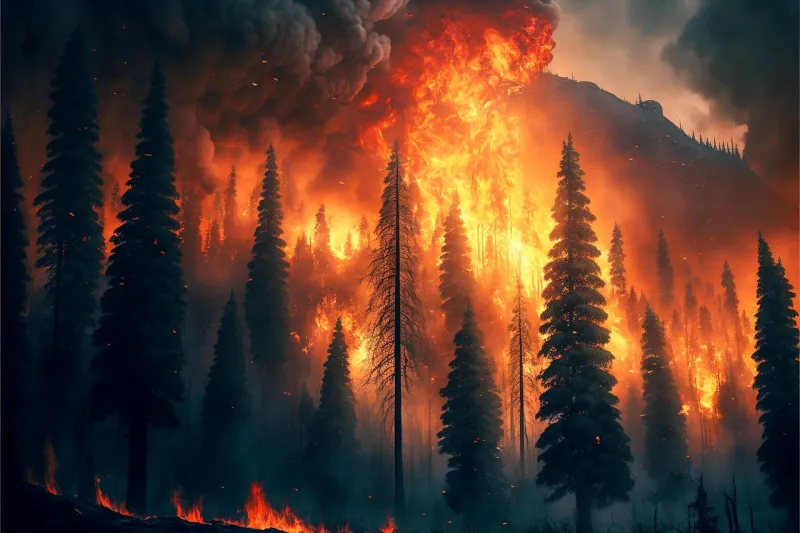
Photo: wildfire approaching archaeological site western United States smoke, via cdn.pixabay.com
Wildfire is not a new force in the American West. It is a longstanding ecological process, one that many Indigenous communities managed and understood long before federal fire suppression reshaped the landscape. But the scale and intensity of recent fire seasons have created a new kind of archaeological emergency. Sites that survived centuries of weathering, looting, and development are now being erased in a single afternoon. The result is a triage problem that is both practical and moral.
A New Kind of Emergency
In 2026, archaeologists working in fire-prone regions are increasingly asked to make rapid decisions under uncertainty. A fire may threaten a rock art panel, a village site, a historic cabin, or a sacred landscape. There is rarely enough time or funding to document everything. Emergency assessments must be prioritized, and prioritization means choosing.
That choice is not neutral. It reflects institutional values, legal obligations, political pressures, and the uneven distribution of archaeological resources. A site with famous artifacts may receive attention while a less spectacular site with deep cultural significance is overlooked. A federal agency may have a mandate to act, but no capacity to do so quickly. A tribe may have the knowledge and the will to protect a place, but not the legal authority or the funding.
The Triage Arithmetic
Wildfire archaeology often looks like a ledger. On one side are the sites that can be documented in time: a quick survey, a drone flight, a photographic record, a few surface collections. On the other side are the sites that cannot. The ledger is never complete, because the fire itself changes the conditions of the calculation. A wind shift can redirect a blaze. A burned slope can reveal new evidence or destroy it.
Emergency excavation is sometimes presented as a solution. It can recover artifacts and record stratigraphy before a site is lost. But excavation is also destructive. It consumes the very resource it seeks to save. In a wildfire context, the pressure to dig can conflict with the principle that excavation should be a last resort. The result is a tension between salvage and stewardship that has no easy resolution.
Who Decides
The ethical stakes are highest when Indigenous heritage is involved. Many archaeological sites in the American West are ancestral places, and many tribes have long argued that they should be consulted—or better, that they should lead—when those places are threatened. Wildfire emergencies can expose the gap between consultation as a procedural box and consultation as a genuine sharing of authority.
In practice, triage decisions are often made by agencies, contractors, and researchers working under tight deadlines. Tribal input may arrive late or be limited to a narrow window. That is not merely a bureaucratic inconvenience. It is a question of sovereignty. If a site is sacred, the decision to document it, excavate it, or let it burn is not only a scientific question. It is a cultural and political one.
Documentation Is Not Preservation
There is a temptation to treat digital documentation as a form of rescue. Laser scanning, photogrammetry, and high-resolution photography can capture a site in remarkable detail. These tools are valuable. They allow researchers to study a place after it is gone and to share information with descendant communities.
But a digital model is not the place itself. It cannot reproduce the relationships between architecture, landscape, and memory. It cannot replace access to a sacred site. It cannot answer the questions that only come from being there. Documentation is a record, not a substitute. When it is presented as preservation, it can become an alibi for inaction.
What We Owe
The wildfire crisis forces archaeologists to confront a uncomfortable truth: not everything can be saved. That truth is not an argument for despair. It is an argument for clarity. If triage is unavoidable, then the criteria for triage should be transparent. Indigenous communities should have a meaningful role in setting those criteria. Funding should follow the values that institutions claim to hold. And the public should understand that archaeology is not only about discovery. It is also about loss.
There is a tendency in heritage work to speak of the past as something that belongs to everyone. In practice, the past is unevenly owned, unevenly protected, and unevenly mourned. Wildfire makes that unevenness visible. It burns through the illusion that we have infinite time to decide what matters.
The question, then, is not whether we will lose archaeological sites to fire. We will. The question is whether we will lose them without consent, without record, and without a serious accounting of what our choices reveal about our priorities. A ledger of loss is still a ledger. It can be kept honestly, or it can be kept badly. The difference matters—not only to archaeologists, but to the communities whose heritage is at stake.