The Heat Still Locked in the Stone: Fire-Cracked Rock and the Recalibrated Peopling of the Americas
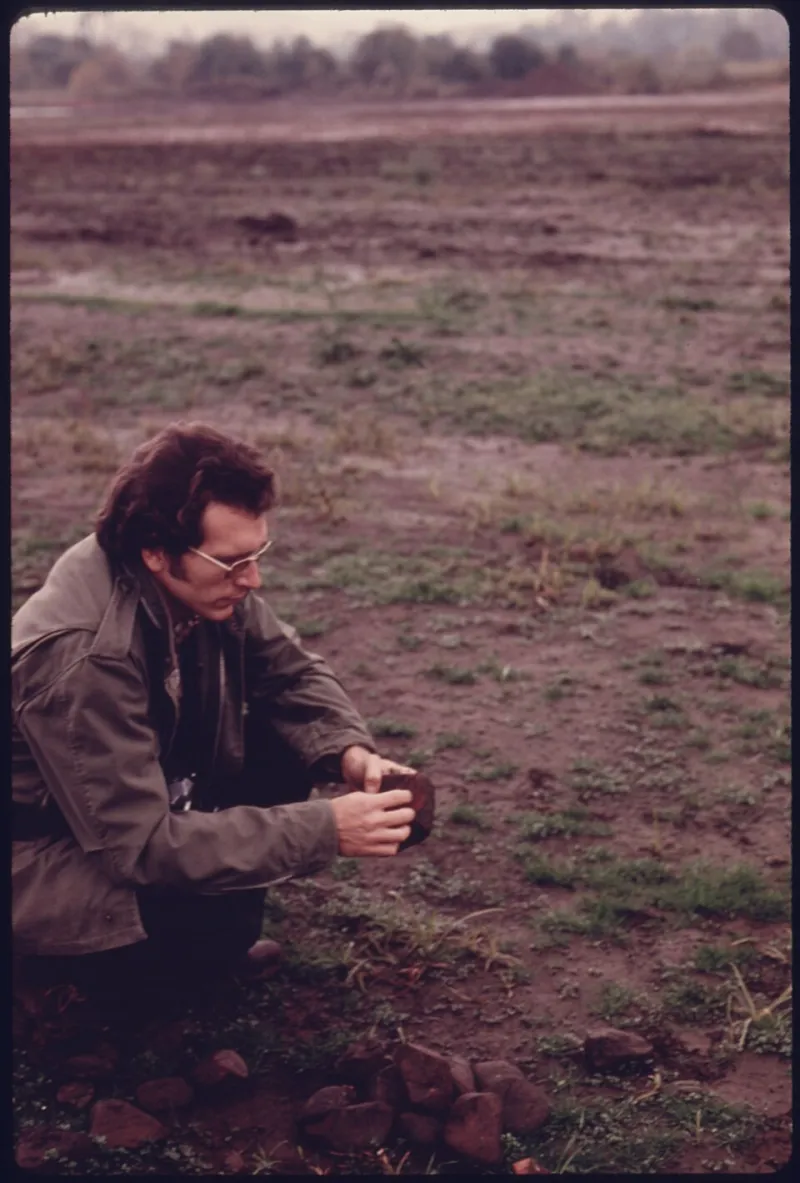
Photo: Frank John Aleksandrowicz, Public domain, via Wikimedia Commons
For generations, fire-cracked rock has occupied an awkward place in American archaeology. It is abundant, heavy, and stubbornly plain. Field crews record it, bag it, and sometimes curse it. Compared with a finely flaked projectile point or a painted sherd, a fractured cobble from an ancient hearth can seem like background noise. That assumption is now being tested in laboratories and excavated pits across North America, where fire-cracked rock is emerging as one of the most promising—and most underappreciated—dating tools in the archaeological toolkit.
A Rock by Any Other Name
Fire-cracked rock, or FCR, is exactly what the term suggests: stone that has been heated and fractured by fire. It accumulates around hearths, roasting pits, sweat lodges, and other thermal features. In the past, its presence was often used as a simple indicator that people had built fires at a site. Its value as a chronological marker was limited by the assumption that burned rock could not be dated directly.
Luminescence dating has changed that calculation. The method relies on the fact that minerals such as quartz and feldspar store energy from natural radiation over time. When stone is heated to a sufficient temperature, that stored energy is released—effectively resetting the mineral clock. Once the stone cools and is buried again, the clock begins to accumulate a new signal. In the laboratory, researchers can stimulate the sample and measure the light released, producing an estimate of when the stone was last heated.
For fire-cracked rock, this is a crucial distinction. A hearth is not merely a place where people ate and slept. It is a fixed moment of human behavior: a fire was built, maintained, and eventually abandoned. If the rock beneath that fire can be dated, the hearth itself can be placed in time.
How Heat Becomes a Clock
The technical work is delicate. Archaeologists must collect samples carefully, avoiding stones that may have been reheated by later fires or exposed to sunlight after excavation. They must also understand the local radiation environment, because the dose a mineral receives depends on the surrounding sediment and the history of the deposit. In some cases, single-grain analyses can help distinguish individual grains that were fully reset by heating from those that were not.
The results are not always precise to a human lifetime. Luminescence dating carries margins of error, and a site with complex stratigraphy can produce ambiguous readings. But precision is not the only goal. For archaeologists working on questions of migration and settlement, a date range that is several centuries wide can still be transformative—especially when the older timeline was built on indirect associations or scattered diagnostics.
This matters because the peopling of the Americas remains one of the most contested subjects in archaeology. The old Clovis-first model, which placed the earliest widespread human presence at roughly 13,000 years ago, has been challenged by sites that appear older. Some of those challenges rest on stone tools, some on genetic evidence, and some on chronometric methods that have themselves been debated. Fire-cracked rock offers something different: a direct date on a human-made thermal feature, rather than an inference from a tool style or a stray artifact.
Why the Timeline Matters
A reliable hearth date can anchor a site in time. It can also test assumptions about how people moved across the continent. Did early groups follow coastal routes and then move inland? Did they occupy interior basins earlier than once thought? How quickly did populations spread into different environments? These are not abstract questions. They shape how archaeologists understand adaptation, mobility, and the social organization of the earliest Americans.
Fire-cracked rock is particularly useful because hearths are common. Unlike rare diagnostic artifacts, burned rock appears at campsites, processing locations, and short-term occupations. If the method can be applied widely, it could produce a denser chronology of human presence across regions that have yielded few organic materials suitable for radiocarbon dating.
That potential has led some researchers to argue that FCR deserves a place alongside charcoal, bone, and shell as a primary dating material. The claim is not that every burned rock is a reliable clock. It is that the category has been dismissed too quickly. In a field where dating is often the bottleneck, a common artifact that can yield a direct age is not background noise. It is a resource.
The Limits of the Method
The enthusiasm comes with caveats. Fire-cracked rock can be reheated, moved, or exposed by erosion. A single hearth may contain stones heated at different times. Sediment mixing can blur the signal. And luminescence dating requires laboratory access and expertise that many cultural resource management projects do not have in abundance.
There is also the question of interpretation. A date on a burned rock tells us when a fire was lit. It does not automatically tell us who lit it, what they were doing, or how the site fits into a broader settlement system. The method is strongest when it is integrated with stratigraphy, artifact analysis, and other dating techniques.
Still, the shift in perspective is significant. Fire-cracked rock was once treated as an artifact of last resort—something to count and discard. As of 2026, it is increasingly treated as an archive of heat, time, and human presence. The stone does not speak in sentences. But it does hold a signal, and archaeologists are learning how to read it.
The Archive in the Ashes
The broader lesson may be about attention. Archaeology often privileges the visually striking object: the point, the pot, the ornament. But the past is also recorded in ordinary things—the stones under a fire, the ash in a pit, the cracked cobble that was once too hot to touch. Fire-cracked rock is not glamorous. It is, however, a reminder that chronology is built from evidence, not assumption. In the effort to understand when people first spread across the Americas, the most revealing clue may be a rock that was once simply in the way.