Embers of Intelligence: What Ancient Hearths Reveal About the Minds That Built Them
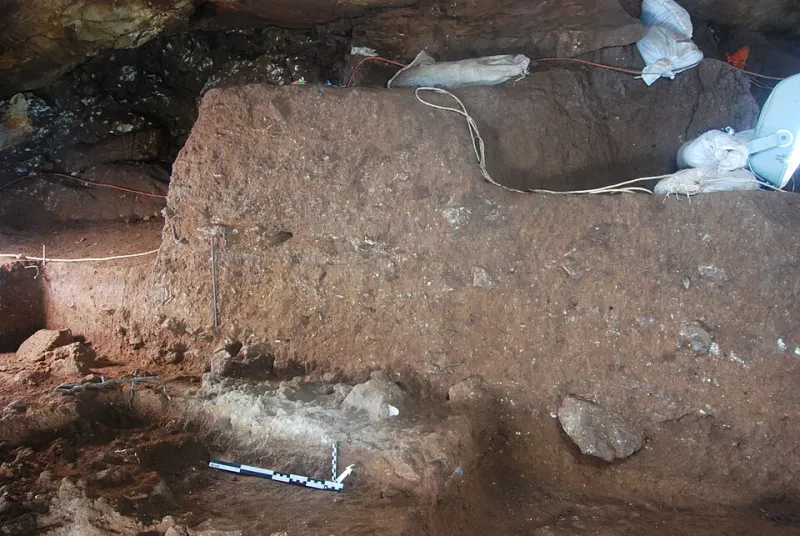
Photo: רון לביא, CC BY 2.5, via Wikimedia Commons
For most of human history, fire was not merely a tool. It was a threshold — a boundary between what came before and what became possible afterward. Archaeologists have long understood that the controlled use of fire represented a pivotal moment in our species' development, but a new wave of research is expanding that understanding in remarkable directions. Hearths, it turns out, are not simply cooking sites. They are archives.
Recent discoveries at sites stretching from South Africa's Cape coast to the limestone caves of northern Spain are challenging the conventional timeline of fire mastery and, more provocatively, suggesting that the cognitive demands of maintaining and sharing fire may have accelerated the very mental capacities that define modern humanity.
Reading the Record in Ash and Bone
The archaeological signature of controlled fire is deceptively complex. A simple campfire leaves behind a constellation of evidence: reddened or heat-fractured sediment, concentrations of charred plant material, burned bone fragments, and — crucially — the spatial arrangement of all these elements relative to one another. It is this spatial logic that excites researchers most.
"When we find a hearth that was repeatedly used and maintained over time, we are not just looking at combustion," explains the framework of current research conducted at sites like Wonderwerk Cave in South Africa, where evidence of fire use dates to approximately one million years ago. "We are looking at intentionality. We are looking at planning."
The distinction between opportunistic fire use — scavenging embers from a natural blaze — and deliberate fire making is one that archaeologists work carefully to establish. Indicators such as the presence of fire-making tools like pyrite nodules and flint strikers, the consistent positioning of hearths within sheltered spaces, and the accumulation of fuel materials nearby all point toward genuine mastery rather than incidental exploitation.
At Qesem Cave outside Tel Aviv, excavations have uncovered a central hearth that was used continuously for roughly 300,000 years, surrounded by evidence of butchery, tool production, and what appears to be communal food sharing. The hearth, researchers argue, was not peripheral to the social life of its occupants — it was the organizing center of it.
Fire and the Social Brain
The implications for understanding early human cognition are substantial. Anthropologists have long theorized that the shift to cooked food — made possible by fire — freed early humans from the energetic demands of digesting raw plant matter, effectively subsidizing the growth of metabolically expensive brain tissue. This is the "cooking hypothesis" associated with Harvard primatologist Richard Wrangham, and it remains influential.
But a newer body of research suggests that fire's cognitive contributions extended well beyond nutrition. Maintaining a fire requires sustained attention, the ability to anticipate future need, and the coordination of group effort. Gathering and storing fuel is a form of planning that stretches across time in ways that most animal behavior does not. Sharing fire — and the warmth, light, and safety it provides — creates conditions for the kind of extended social bonding that language may have evolved to support.
Polly Wiessner, an anthropologist whose fieldwork among the Ju/'hoansi people of southern Africa has been widely cited, found that firelit evenings consistently produced a different quality of conversation than daytime interactions. Nighttime fireside talk was dominated by storytelling, the exchange of information about distant people and places, and the negotiation of social relationships. Daytime talk was largely practical. Fire, in other words, may have created the social and temporal space in which human narrative first flourished.
Rethinking the Timeline
Perhaps no aspect of fire research has generated more debate than the question of when, precisely, our ancestors crossed the line from passive fire users to active fire makers. The traditional consensus placed reliable evidence of controlled fire at roughly 400,000 years ago, with earlier claims treated skeptically. That consensus is now under significant pressure.
At Wonderwerk Cave, a team led by Francesco Berna of Simon Fraser University identified burned bone and plant ash in sediment layers dating to one million years before present, associated with Homo erectus rather than anatomically modern humans. The spatial distribution of the burned material — concentrated rather than scattered, as natural fires would produce — strongly suggests deliberate use.
Even more provocatively, some researchers have proposed evidence of fire use at Homo erectus sites in East Africa approaching 1.5 million years in age, though these claims remain contested. The debate hinges partly on methodology: distinguishing ancient anthropogenic fire from naturally ignited burning in sediment that has been compressed, shifted, and altered over geological timescales demands extraordinary analytical precision.
Modern techniques are rising to meet that challenge. Micromorphology — the microscopic examination of sediment structure — allows researchers to identify the layered patterns of ash deposition that characterize repeated, maintained fires. Fourier-transform infrared spectroscopy can detect the chemical signatures of heated bone and plant material even when visible traces have long since degraded. These tools are not merely refining existing conclusions; in several cases, they are overturning them.
Migration, Climate, and the Spread of Fire
Beyond cognition and social behavior, fire evidence is increasingly informing our understanding of how early human populations moved across the landscape. The ability to generate heat and light extended the habitable range of our ancestors into colder latitudes and higher elevations that would otherwise have been inaccessible. The timing of fire mastery, plotted against the paleoecological record of climate shifts and migration corridors, offers a new lens through which to examine the peopling of Eurasia.
At Beeches Pit in Suffolk, England, archaeologists have documented fire use dating to approximately 400,000 years ago, a period of relative climatic warmth. The presence of fire at such a northerly latitude during this period suggests that Neanderthal predecessors — likely Homo heidelbergensis — were not simply tracking favorable conditions but actively modifying their relationship to challenging environments.
This is a distinction with profound implications. A species that can create fire is not merely adapting to the world as it finds it. It is, in a meaningful sense, beginning to reshape that world according to its own requirements. The hearth, viewed through this lens, is not just evidence of what early humans could do. It is evidence of what they were becoming.
The Fire We Carry Forward
For American audiences accustomed to thinking of archaeology as the province of distant civilizations and museum display cases, the study of ancient fire offers something unusually intimate. Every human being alive today is descended from populations that gathered around fires, told stories in the dark, and passed knowledge across generations through the medium of shared warmth. The hearths archaeologists excavate are not relics of a foreign species. They are the oldest rooms our ancestors ever occupied.
As analytical techniques continue to improve and excavations push deeper into the record, the story those hearths tell grows richer and more nuanced. What emerges is not a simple narrative of technological progress but a portrait of minds in formation — minds that fire helped to build, and that fire, in turn, helped to define.