Five Feats of Ancient Engineering That Modern Science Hasn't Matched
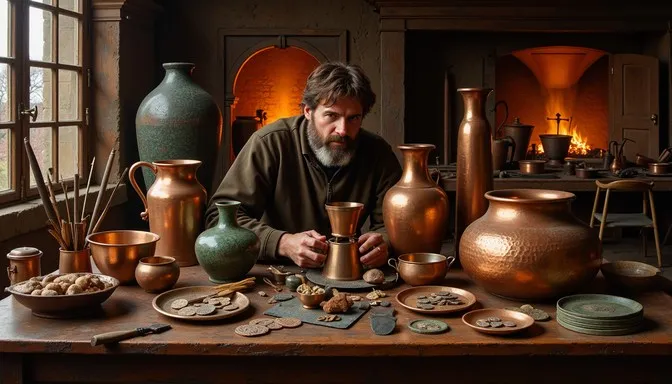
Photo: experimental archaeologist copper working ancient craft workshop, via images.stockcake.com
We tend to assume that modern technology can reproduce anything the past accomplished. Often it can. But in a growing number of cases, engineers and materials scientists attempting to recreate ancient American technologies have run into walls — not of skill, but of knowledge that died with its makers.
1. Maya Water-Hardening Plaster
Maya lime stucco, found on temples across Mesoamerica and in sites stretching into the modern United States' sphere of trade influence, hardens even when submerged — a property ordinary lime plaster lacks. Researchers believe organic additives, possibly plant saps and bark extracts, altered the crystal structure of the lime, but decades of trials have produced only partial imitations. 'We can get close,' one experimental archaeologist notes, 'but close isn't the same as identical, and identical matters if you want to understand the minds behind it.'
2. Adena and Hopewell Copperworking Without Heat
The copper objects of the Ohio Valley — ceremonial blades, breastplates, and ornaments — were shaped through cold-hammering and annealing techniques that produced seams and edges of remarkable precision, all without melting the metal. Replicating the annealing schedules, which controlled brittleness without softening the form, remains a matter of trial and error rather than settled science.
3. Mississippian Shell Tempered Pottery
Ceramics of the Mississippi River valley were tempered with crushed shell in proportions that allowed thin-walled vessels to survive repeated thermal shock over cooking fires. Modern potters working with the same clays routinely produce wares that crack where the originals endured.
4. Chipped Stone Mastery
Flintknappers can today produce beautiful Clovis-style points, but reproducing the extraordinary thinning flakes of the finest Paleoindian specimens — removing flakes that span the entire face of a point — remains a benchmark few living knappers have achieved.
5. Desert-Proof Earthen Architecture
In the Southwest, ancestral Puebloan masonry and earthen plasters have withstood centuries of freeze-thaw cycles in environments that destroy modern equivalents within decades. The mortar recipes and aggregate choices embedded in those walls are still being decoded.
Why It Matters
Each failed replication is a reminder that ancient technologies were not primitive approximations of ours, but complete knowledge systems — refined over generations and, in many cases, irretrievably lost. Experimental archaeology is not nostalgia. It is one of the few methods available for recovering knowledge that left no written trace.